


↵
CNCR: Leading Directional Coupler Supplier
CNCR is a global leading supplier providing telecom access network solutions. Since the company was successfully listed in 2011, CNCR has always adhered to independent research and development and technological innovation, and successfully passed the highest level CMMI5 certification in the global software field.
-
![20db Directional Coupler]() 20db Directional CouplerDirectional coupler is a general microwave / millimeter wave component, which can be used for signal isolation, separation and mixing, such as power monitoring, source output power amplituderead more
20db Directional CouplerDirectional coupler is a general microwave / millimeter wave component, which can be used for signal isolation, separation and mixing, such as power monitoring, source output power amplituderead more -
![20db Rf Directional Coupler]()
-
![10db Coupler Rf]() 10db Coupler Rf●Low Insertion Loss. ●High power handing. ●Small size, Low weight. ●N-Female connecters.read more
10db Coupler Rf●Low Insertion Loss. ●High power handing. ●Small size, Low weight. ●N-Female connecters.read more -
![3db Rf Directional Coupler]()
-
![15db High Power Directional Coupler]() 15db High Power Directional Coupler2000-6000Mhz,15db High Power Directional Coupler. Low Variation of Coupling Attenuation. High directivity/ Isolation, Low VSWR/Insertion Loss. Broad Band Operating Frequency Range.read more
15db High Power Directional Coupler2000-6000Mhz,15db High Power Directional Coupler. Low Variation of Coupling Attenuation. High directivity/ Isolation, Low VSWR/Insertion Loss. Broad Band Operating Frequency Range.read more -
![30db Coupler in Microwave]() 30db Coupler in MicrowaveApplied to the network sites demanding for corresponding signal strength and also as a signal power monitoring device.read more
30db Coupler in MicrowaveApplied to the network sites demanding for corresponding signal strength and also as a signal power monitoring device.read more -
![10db SMA Directional Coupler]() 10db SMA Directional Coupler●Low Insertion Loss. ●High power handing. ●Small size, Low weight. ●N-Female connectersread more
10db SMA Directional Coupler●Low Insertion Loss. ●High power handing. ●Small size, Low weight. ●N-Female connectersread more -
![6db Directional Coupler in Microwave]() 6db Directional Coupler in MicrowaveWork frequency 698-3600Mhz . Low Variation of Coupling Attenuation. High directivity/ Isolation, Low VSWR/Insertion Loss. Excellent PIM. High Average Power Rating. Multiple IP degree.read more
6db Directional Coupler in MicrowaveWork frequency 698-3600Mhz . Low Variation of Coupling Attenuation. High directivity/ Isolation, Low VSWR/Insertion Loss. Excellent PIM. High Average Power Rating. Multiple IP degree.read more -
![20db Coupler]() 20db CouplerWork frequency 800-3600MhzLow Variation of Coupling Attenuation. High directivity/ Isolation, Low VSWR/Insertion Loss. Excellent PIM.read more
20db CouplerWork frequency 800-3600MhzLow Variation of Coupling Attenuation. High directivity/ Isolation, Low VSWR/Insertion Loss. Excellent PIM.read more -
![3db Directional Coupler]() 3db Directional CouplerDirectional couplers are used as a measuring device to monitor the coupling out signals. The coupling value is from 3 dB to 60 dB or more.read more
3db Directional CouplerDirectional couplers are used as a measuring device to monitor the coupling out signals. The coupling value is from 3 dB to 60 dB or more.read more -
![5db Directional Coupler]() 5db Directional CouplerDirectional coupler is a generic microwave/millimeter wave components, can be used to signal isolation, separate and mix, such as the power source of monitoring, the output power stability, signalread more
5db Directional CouplerDirectional coupler is a generic microwave/millimeter wave components, can be used to signal isolation, separate and mix, such as the power source of monitoring, the output power stability, signalread more -
![10db Directional Coupler]() 10db Directional CouplerApplied to the network sites for corresponding signal strength and also as a signal power monitoring device. They are the key components in the in-building systems.read more
10db Directional CouplerApplied to the network sites for corresponding signal strength and also as a signal power monitoring device. They are the key components in the in-building systems.read more


Directional couplers are used as a measuring device to monitor the coupling out signals. The coupling value is from 3 dB to 60 dB or more.
Applied to the network sites demanding for corresponding signal strength and also as a signal power monitoring device.
Why Choose Us
Professional Engineer
500+ experts provides innovative solutions to ensure project quality and reliability.
Customizable R&D
Meet personalized needs, reduce costs, protect intellectual property rights, improve competitiveness, and enhance user experience.
Real-Time Support
7*24 hours global technical support service, quickly solve problems and improve user experience.
Certified Quality
CNCR products have passed various international certifications such as ISO, CE, ROHS, improve customers' market competitiveness.
Specification
|
Part number |
ZHCP-408020NS-2U1A |
|
Coupling(dB) |
20 |
|
Frequency (MHz) |
4000-8000 |
|
Insertion Loss(dB) |
≤0.3 |
|
Ripple in band(dB) |
≤±1.5 |
|
Directivity(dB) |
≥20 |
|
VSWR |
≤1.2 |
|
Impedance(Ω) |
50 |
|
PIM3(dBc)* |
N/A |
|
Connectors |
N-F/SMA-F |
|
Power rating(W) |
100 |
|
Temperature(℃) |
-30~+70 |
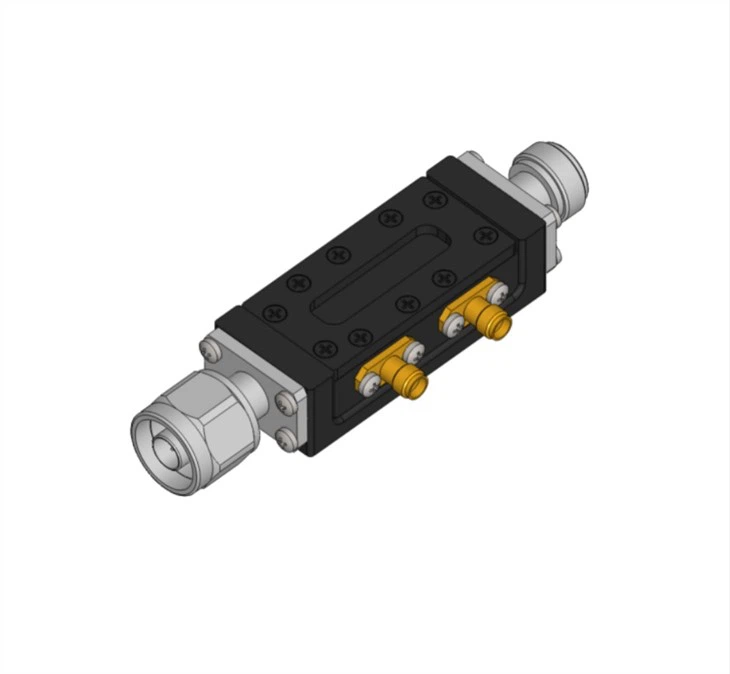
Construction of Directional Couplers
Directional couplers are commonly built the use of a number of technology, together with microstrip, strip line, or waveguide configurations:
Main Line
Carries the number one sign from the enter to the output port.
Coupled Line
Connected to the coupled port, extracts a part of the sign for coupling.
Isolation Line
Isolates the coupled and remoted ports to minimize signal leakage.
Key Ports in a Directional Coupler
Input Port
Where the main RF signal is fed into the coupler.
Output (Through) Port
The main signal continues through this port with minimal insertion loss.
Coupled Port
Receives a small fraction of the input signal.
Isolated Port
Ideally has no signal in the direction opposite to the coupled port (terminated to prevent reflection).
Benefits of Directional Coupler
Enhanced Signal Integrity
One of the primary benefits of utilizing directional couplers is enhanced signal integrity. By ensuring minimal interference with the main signal path, directional couplers maintain the original signal’s strength and quality.
Improved Measurement Accuracy
Another significant benefit is the improved measurement accuracy offered by directional couplers. High directivity and isolation enable precise differentiation between forward and reflected signals.
Compact Size
Directional couplers are small-footprint, low-profile devices, of which microstrip or stripline types are particularly compact, so they can be built into PCBs and RF modules.
Minimal Insertion Loss
A well-designed directional coupler introduces very low insertion loss in the main line. That means it barely affects the power or quality of the transmitted signal.
Durable and Reliable
Directional Coupler with high-quality materials and advanced engineering, the coupler is highly durable and reliable, providing long-term operation without degradation in performance.
Applications of Directional Couplers
Power Monitoring: Directional couplers are appreciably used for electricity monitoring in communique networks. By extracting a fragment of the signal power without good sized interference, they enable accurate dimension and monitoring of energy levels.
Signal Sampling: In check and measurement setups, directional couplers are hired for sign sampling. They facilitate the extraction of consultant samples of signals for analysis with out affecting the number one signal path.
Network Analysis: Directional couplers play a key function in network analyzers, helping within the evaluation and characterization of RF circuits. They allow the dimension of meditated and transmitted alerts, helping engineers understand the behavior of the network.
Antenna Systems: Directional couplers are essential components in antenna structures, facilitating the tracking and adjustment of sign levels. They ensure that the alerts transmitted and obtained by way of antennas are correctly managed.
Amplifier Systems: In amplifier structures, directional couplers are used for signal sampling and tracking at various tiers. This allows optimize amplifier overall performance and guarantees that alerts are within preferred strength degrees.
Balanced Signal Processing: Quadrature hybrids, a type of directional coupler, find packages in balanced signal processing. They are utilized in structures in which specific phase relationships between indicators are critical, including in segment-locked loops and balanced modulators.
Transceiver Systems: Directional couplers are employed in transceiver structures for signal tracking and comments. They play a function in maintaining sign integrity, making sure that transmitted and obtained alerts meet distinct criteria.
Microwave Systems: Microwave communique systems gain from directional couplers for tasks along with electricity splitting and mixing. They make a contribution to efficient signal distribution and control in microwave packages.
RF Filters and Duplexers: Directional couplers are used together with RF filters and duplexers to split or combine alerts in frequency department duplexing (FDD) structures. This is commonplace in wireless verbal exchange networks.
Laboratory Instruments: Directional couplers are critical additives in diverse laboratory devices, such as spectrum analyzers, vector community analyzers, and oscilloscopes. They facilitate accurate signal measurements and evaluation.

☆Ensure the directional coupler operates within the specified frequency range of the system to maintain accurate coupling and isolation performance.
☆Verify that the input and coupled ports can handle the maximum expected power level without causing damage or distortion.
☆Always terminate the isolated port with the correct load to prevent signal reflections and measurement errors.
☆Install the coupler in an environment that meets its rated temperature, humidity, and mechanical stability specifications to ensure long-term reliability.
- Send us your order list (models/quantities/specification).
- We will send you PROFORMA INVOICE (PI) with shipping cost and Payment information for your confirmation.
- You arrange payment after you confirmed proforma invoice, we will arrange production after received your payment notice.
- We will arrange delivery after your payment arrived and goods ready,and at the same time we will tell you goods tracking number so that you could know your goods condition by this number from courier site.
- You will receive your order in about 3-5 days after goods ship out.
Packaging & Shipping
|
Trade Terms: |
FOB, CIF, CFR, etc |
|
Price Terms: |
T/T, Western Union, Paypal, L/C, RMB, Credit Card |
|
Lead Time: |
Generally, if the goods are in stock, shipment can be arranged within 3 working days; If the goods need to be mass produced, delivery time may be around 7-10 working days. |
|
Shipment: |
Express, Air, Sea |
|
Package Information: |
Standard carton package with the original package |
Video
Patents & Certificates
In pursuing innovation of cutting-edge technologies, CNCR has been publishing patents every year.




Factory Environment


FAQ
We're well-known as one of the leading directional coupler manufacturers in China since 1999, specialized in providing high quality customized products. Welcome to buy cheap directional coupler for sale here from our factory. For price consultation, contact us.
simplified access, compact gpon mdu, gpon mdu for energy management